 by
by Saturday, 16th May 2026, in the middle of the night in Vienna. Germany, the United Kingdom and Belgium shared the same faith. Zero points from the public. Nobody loves you? The show hosts were not tired to say that this “only” means that you did not make it into the Top 10 of any of the global votes. Nonetheless, zero points is a harsh and tough statement. I again felt that this vote is not working. Not because “my” country Germany did not make it, just because it is not fair in my point of view. Thus, I felt to blog about the public vote at the Eurovision Song Contest (ESC).
Public Vote vs. Jury Vote at the Eurovision Song Contest
Determining the winner at the Eurovision Song Contest currently is a rather straight process. Any of the participating countries, including the ones who failed in the semifinal(s) are allowed the vote. The Top 10 songs per country are given points, in the staggering 12-10 and 8 down to 1. Thereby, any country has in fact two votes, one with a previously assigned jury (the jury vote) and one done by the spectators (the public vote). You cannot vote for your own country, obviously. Vienna 2026 had 35 participants, 25 of them competing in the finals. In general the jury and the public vote points count the same. However, there are two “advantages” for the public vote:
- There is also an additional combined public vote for all countries which did not compete in that year, including countries which are not in Eurovision scope, like the USA. Thus, in Vienna, there were 36 public voting blocks and 35 jury votes.
- In case of a tie of the combined score, the higher public vote decides the winner.
Thus, in theory, the maximum possible score a contestant could reach in Vienna was 12 points * (34 jury votes + 35 public votes) = 828 points. Under that circumstance, the winning score of 516 for Bulgaria is rather impressing.
Why The Public Vote is Even More Important
I looked at the last ten ESC winners. My focus was the distribution of jury and public points in the total score.
| Year | Winning Country | Jury Points | Public Points | Total | Public % |
| 2026 | Bulgaria | 204 | 312 | 516 | 60.5% |
| 2025 | Austria | 258 | 178 | 436 | 40.8% |
| 2024 | Switzerland | 365 | 226 | 591 | 38.2% |
| 2023 | Sweden | 340 | 265 | 605 | 43.8% |
| 2022 | Ukraine | 192 | 439 | 631 | 69.6% |
| 2021 | Italy | 206 | 318 | 524 | 60.7% |
| 2019 | Netherlands | 237 | 261 | 498 | 52.4% |
| 2018 | Israel | 212 | 317 | 529 | 59.9% |
| 2017 | Portugal | 382 | 376 | 758 | 49.6% |
| 2016 | Ukraine | 211 | 323 | 534 | 60.5% |
In seven cases, the winning song received more points from the public vote than from the jury. The difference is much higher than you would expect from the additional public vote. I did a similar analysis, summing up the points of the Top 5 ranked songs and again determining the share of public vote points to the total ones:
| Year | Top 5 Jury Points | Top 5 Televote Points | Top 5 Total Points | Public Vote Pct |
| 2016 | 1006 | 1098 | 2104 | 52.19% |
| 2017 | 1096 | 1358 | 2454 | 55.34% |
| 2018 | 929 | 1026 | 1955 | 52.48% |
| 2019 | 826 | 1197 | 2023 | 59.17% |
| 2021 | 1016 | 1181 | 2197 | 53.76% |
| 2022 | 1051 | 1255 | 2306 | 54.42% |
| 2023 | 895 | 1194 | 2089 | 57.16% |
| 2024 | 991 | 1420 | 2411 | 58.90% |
| 2025 | 701 | 1025 | 1726 | 59.39% |
| 2026 | 690 | 1033 | 1723 | 59.95% |
| Total | 9201 | 11787 | 20988 | 56.16% |
In any of the last ten editions (2020 did not take place due to Covid-19)), the top 5 song in total always received more points from the public vote than from the jury vote. With a mean of 56 per cent. I did this analysis and statistics after I started working on this post. However, it in the range I expected. I will explain the reason in the next chapter.
Why I Feel That Public Vote Should Be Reformed?
At first sight, it feels like each country is doing two sets of points, based on different people and expertise. However, they also do it in fact on a very different voting system (which also explains the expectation I mentioned above. Let’s have a deeper look:
How The Jury Vote is Working
In 2026, each national jury consisted of seven members. These were disclosed after the competition, but should be confidential beforehand. The members are music professionals, but also diverse in their compositions. Thus, there may be music professionals, music journalists, but also music teachers are possible. Two jury members at least have to be between 18 and 25 years old. They should obviously not be connected to any participating artist or songwriter. They have to rank all songs individually and independently, based on rehearsal sessions of the shows. Based on that ranking, the national head of the jury transforms these votes into the points given by that country (see also Rules of the Contest by the EBU).
How The Public Vote is Working
The mechanisms of the public vote are rather straight-forward. Based on your geographical location, you are voting for your favorite song. The result of all votes of a country or the Rest of the World voting determines a ranking, on which the typical points are given.
There are a few details worth mentioning:
- You may typically vote by phone call, text message or the Eurovision app
- The maximum number of votes one can give has recently been reduced to ten
- The votes are charged. The price per vote differs from country to country and differs significantly by country. In 2026 Finland was the most expansive country with 1.50 EUR / vote, while Denmark was the cheapest (0.13 EUR / vote). You can find a nice overview (in Finnish language) in this X post. In English, there is a Reddit post about the 2025 situation.
Unfortunately, there is very little reliable data about the votes in regards of the number of votes and distribution. For the 2025 ESC, the website ESCInsight estimated a total of 17m votes all over Europe. I found similar ballpark figures in other sources as well. The post also estimates the number of voters by country. According to their model, there were over four million voters each from Germany and the United Kingdom, which is by far the largest number. Countries like Montenegro, Moldova, or Georgia come with less than 5,000 votes each, according to that source.
There is no information which method people typically use for voting. In May 2026, the Spanish newspaper El Pais released a report that for the 2025 vote in Spain, the distribution was:
- 7,283 phone calls (5 %)
- 23,840 text messages (17 %)
- 111,565 online votes (78 %)
I would guess, though that the shares differ between the costs for the different votes.
Public Vote Mechanism and Topics
There are two key topics I would like to discuss about the public vote and the national public voting results. However, both come with limited authorized available information.
Split Voting
One of my favorite statements about the public vote is If everybody in a country thinks you did the second best song, you will receive zero points. The idea behind that is, however, that people don’t split their votes. Having up to ten votes available, however, does give you the opportunity to give some votes to one song and a little less to your almost-as-much beloved track (or even to three or more songs).
There are just estimates about how many viewers do this vote splitting. Most agree that a split vote is extremely unusual under “casual” ESC viewers. However, there is a certain popularity for it among ESC fans. For vote-splitters, my statement above might not be true. If everybody did vote-splitting and had the same favorite and second favorite song, you would end up with 10 points from that region. There are estimates that between 20 and 40 per cent of the votes do vote splitting (which might also suggest that it is majorly the ESC community delivering the votes).
Distribution of Votes over the Different Nations
I start this section with another statement, which is a fact and not an opinion: If you are eleventh placed in the public votes of any country, you will end up with zero points from that category globally. This is fact, only the first ten countries receive points. The more, it is interesting how big the voting gaps between a place in the points like the eighth or ninth place and a spot right outside these ranks, e.g. eleventh or twelfth, in regards of votes really is.
Unfortunately, there is just very limited public voting data in regards of total number of votes for a country. The best data comes from Italy. I give you a few sources in here:
- Percentual distribution of Italian votes for 2026, for the (first) semifinal and final, by RAI (Italian national TV, 17th May 2026, pdf)
- The same data for 2026, including an average of the 2021 to 2025 shows (ESCInsight, 2nd June 2025)
- Total votes of Estonia at the ESC 2012 finals (by ESCToday, 19th May 2012)
Especially the distribution of votes chart
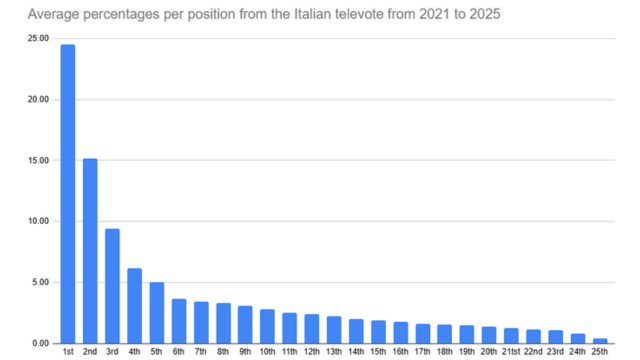
In comparison, I used the official 2026 figures from RAI and used the ESCInsight estimate from 2025 that there are about 1.1 million televotes from Italy. I also added the cumulated pct., i.e. the share of votes given up to this place. The value for Albania, for example, is the share of votes for the four most popular songs in the Italian vote:
| Country | Votes | Pct. of Votes | Cummulated | |
| 1 | Moldavia | 241.780 | 21,98% | 21,98% |
| 2 | Romania | 155.540 | 14,14% | 36,12% |
| 3 | Israel | 125.070 | 11,37% | 47,49% |
| 4 | Albania | 116.490 | 10,59% | 58,08% |
| 5 | Ukraine | 112.310 | 10,21% | 68,29% |
| 6 | Bulgaria | 81.950 | 7,45% | 75,74% |
| 7 | Greece | 31.570 | 2,87% | 78,61% |
| 8 | Finland | 25.960 | 2,36% | 80,97% |
| 9 | Poland | 23.760 | 2,16% | 83,13% |
| 10 | Australia | 22.220 | 2,02% | 85,15% |
| 11 | Croatia | 21.120 | 1,92% | 87,07% |
| 12 | Serbia | 19.250 | 1,75% | 88,82% |
| 13 | France | 17.820 | 1,62% | 90,44% |
| 14 | Malta | 16.280 | 1,48% | 91,92% |
| 15 | Germany | 11.880 | 1,08% | 93,00% |
| 16 | Denmark | 11.660 | 1,06% | 94,06% |
| 17 | Norway | 11.660 | 1,06% | 95,12% |
| 18 | Cyprus | 10.890 | 0,99% | 96,11% |
| 19 | Switzerland | 10.120 | 0,92% | 97,03% |
| 20 | Czechia | 8.800 | 0,80% | 97,83% |
| 21 | Lithuania | 6.600 | 0,60% | 98,43% |
| 22 | Austria | 6.050 | 0,55% | 98,98% |
| 23 | Belgium | 5.720 | 0,52% | 99,50% |
| 24 | United Kingdom | 5.280 | 0,48% | 99,98% |
You see that there is a massive concentration of votes on the top songs. 58% of the votes are given to the first four songs, 75% to the Top 6. The tail is very flat, which means that the difference between zero points and four or five may be marginal, especially in a smaller country. This is a key disadvantage of the public vote compared to the jury vote, where you have to give a ranking for each and every song. If you are last in a country’s jury vote, these expert really judged that your song has been the worst of that day. If you get zero points in the public vote, it finally just tells you that you just very rarely made it to the very top of the people’s minds. You might still be one of their favorites.
Public Vote Issues
Of course, people in other countries than Italy might vote for other songs and countries. However, I feel that the general characteristics how the public vote distributes over songs will be very similar – at least, if you assume that there are just fair votes without the intention of manipulation. To me the key issues with the public votes are:
- The televoting concentrates too much on the people’s favorite. Already in the lower points area of each participating country, the voting result becomes vague. Of course, the spotlights should be on the winner, but currently, the worst song in the ranking might not actually be the worst song in the mind of the people worldwide, who participated in the vote, including the jury.
- As mentioned, the public vote is likely already significantly more important than the jury vote. I feel you should try to reduce the points you get from a public vote. Currently telling the people that they are equal is not based on statistical evidence.
- Manipulation is a big topic. There are some mechanisms against vote manipulation. But being a safe public vote winner in a country by “creating” some 1,000 votes there (if you for example look at the Azerbaijan estimate of 1,500 votes total in the ESCInsight post) feels very tempting. We already saw the last year that the ESC is becoming a “social media battle” two or three weeks before the final. In that context, voting fees of up to 1.50 EUR per vote make the people worse. You have to be a real die-hard ESC nerd if you pay 15 Euro for ten votes in Finland.
- It is also uncertain how many votes one person can in fact do without major effort. The online vote (at least in Germany) is limiting you to ten votes per payment card, the text message voting is by cell phone and you could use your mainline phone for the phone-based voting.
I do understand that the organizing body EBU is shy of publishing detailed figures about the public vote. It may give people hints how to manipulate voting efficiently in financial and resource effort. On the other hand, you might also be able to detect fraud, e.g. by using data analytics experts.
How Would I Alter The Public Vote
I feel that there should still be a jury and public vote. The jury leads to a certain stability. I can neither judge whether the countries did sensible jury in the past or whether jury members were known before the competition. On the public vote side, I would ask people to generally vote for their favorite three songs. The first placed song might receive a stronger weight than the others. I like this idea because it puts the public vote on a wider foundation.
If I look at my statement above, a song regarded second best by all voters (and having a common favorite) will become second in the public vote, just as you would love to have it. I would also expect that there is a weaker share of votes on a few top songs, so that the result for the less popular songs is more precise. It may be that a vote for multiple songs may be difficult by phone voting, but this kind of public vote becomes less important anyway. It should be no issue for text and online voting.
Increase The Participation
Additionally, I would try to push for lower voting prices. More votes means less opportunity to have fraudulent votes. It also leads to more precise and more widely accepted results. The results should also be shared in detail, at least as percentages as the Italian RAI is doing. Also the idea of having three songs you have to pick makes manipulation more difficult. If you want to systematically support a certain contestant, you at least have to choose a second and third song as well. Irregularities in votes might be much easier to detect with modern data analytics methods.
What do you think about these ideas? Happy to discuss with you…
All “classic” blog posts
No reviews – just debating and certain topics. These are my “traditional” blog posts in the categories Just blogging, Just blogging on music and Sports Blogging:

BV Borussia Dortmund – CSM Bucuresti 35-32 (13-20)

We Will Always Love You – R.I.P. Dolly Parton

Who Treats Me Best? My Favorite Loyalty Schemes

AI, Give Me a New Flyctory.com Banner!
The Eurovision Song Contest 2026 – I am Rating All Songs
Using the Power Socket? Not Allowed! About a Weird Hotel Experience in Switzerland

My Loyalty Portfolio 2026

20 Years Later – The (Mountain) Sites of the 2006 Torino Winter Olympics

What’s Up, Country Music in Europe?

Country To Country 2026 in Berlin – My Thoughts

My Five Hot Takes and Thoughts about the Milan-Cortina Olympic Winter Games 2026

The Flyctory.com-Style Medal Count of the 2026 Milan/Cortina Olympics

Praising a Flight Crew – My Recent Eurowings EW 1778/1779 Experience

The Whoopgate – My Thoughts about Wearables in Sports

70 Years of ESC – The Eurovision Song Contest is Coming To You

Faroe Islands Fans at The EHF Euro 2026 in Oslo

The C2C Berlin 2026 Line-Up is finalized – Here are my Favorites

My Wishes for the Floorball Year 2026 (or later…)

Flyctory.com Best Ones 2025

Flyctory.com – My Favorite Albums / EPs 2025

Flyctory.com – My Favorite Songs 2025

2025 – My Year in Travel

My Twelve Favorite Songs about Feeling Cologne

Flyctory.com goes LinkedIn with a monthly update

The Sheep Islands Did It Again – My Thoughts about the Success of Sports on the Faroe Islands

200 Episodes of “Songs of the Week” – Here are my favorite ones

I’m bringing back the New Country Songs Playlist

Direct Trains from Germany to London – Will It Ever Happen?

After the Intermediate Report has been released – My Thoughts About the Air India 171 Incident

Flyctory.com Introduces the Featured Athletes – here is my first selection

Flyctory.com Turned Off the Ads – Time for some Transformation

Marc-Andre Fleury made me do it – the (weird) Story of a Weekend in May 25
The Most Airports by Country I Have Flown To

Festivals and Open Airs – I Am Looking Forward to Summer 2025

Food I Had Onboard XXII (February 2025 – March 2025)

CMA Fest 2025 Lineup Announced – My Guide to the Festival

My Loyalty Portfolio 2025

C2C Country To Country Berlin 2025 – Splitter and Reprise
My Country To Country Berlin 2025 Preview

Let’s Praise Modern German Country Music – My Artist Overview

Food I Had Onboard XXI (January 2024 – early February 2024)

The Flyctory.com Country Music Playlists – My Favorite Artists

Food I Had Onboard XX (November 2024 – early January 2025)

Flyctory.com Best Ones 2024

Flyctory.com – My Favorite Albums / EPs 2024

Flyctory.com – My Favorite Songs 2024

2024 – My Year in Travel

Looking Forward To 2025 – My Highlights of The Next Year

4,000 Postings on Flyctory.com – Time to have a look back

Bye-Bye Lufthansa – my last Senator Anniversary

Food I Had Onboard XIX (October 2024)

Rock of Ages – 2025 International Dates of the Musical

Food I Had Onboard XVIII (end July to mid September 2024)

“Goldenes Oval” Opening Meeting – Opening Ceremony (Dresden, 30th August 2024)

Paris 2024 Olympics – My Tops and Flops

The Flyctory.com-Style Medal Count of the 2024 Paris Olympics

Food I Had Onboard XVII (mid-May to mid-July 2024)

International Tennis Hall of Fame – Class of 2024 Induction

International Tennis Hall of Fame – 2024 Inductees Press Conference

Infosys Hall of Fame Open 2024 – A Week of Tennis, Indian Celebrations, and a Farewell

NHL Schedule 2024-25 – My Suggested Trips

Rock of Ages – Which song is better? Original or Musical Version?

Food I Had Onboard XVI (mid-April to mid-May 2024)

WFC 2024 in Lahti – Splitter, Stats, & 3×3 Thoughts

The NY Sightseeing Pass or the New York Pass by Go City – Which One is better?
The Debut – Just One Week Until the 3×3 World Floorball Championships in Lahti

My Preview to the Under 19 Girls World Floorball Championships in Lahti

Flyctory.com Is Introducing “Featured Clubs” – Sports Teams & Federations in Focus

Food I Had Onboard XV (March 2024 – early April 2024)

My 15 Favorite Hotels I Have Stayed in… So Far

My Loyalty Program Portfolio 2024

Food I Had Onboard XIV (January 2024 – early March 2024)

The Renewed Flyctory.com Country Music Playlists

Andreas Dorau – My Most Favorite Songs and Lines

Food I Had Onboard XIII (End November 2023 – early January 2024)

Flyctory.com Best Ones 2023

Flyctory.com – My Favorite Albums / EPs 2023

Flyctory.com – My Favorite Songs 2023

2023 – My Year in Travel

Santa’s Soundtrack 2023? Some Christmas Releases This Season
The Day Music Neutrality Died (a bit) – Thank You Everynoise.com

Food I Had Onboard XII (Late October 2023 – Mid-November 2023)

Naughty or Nice? – The Flyctory.com Country Christmas Playlist 2023

Country To Country is back in Central Europe – Here are the Main Acts

Food I Had Onboard XI (Mid September 2023 – October 2023)

The Privilege of the Loo – On Bathroom Distribution in Airplanes

Rock of Ages – 2024 International Dates of the Musical

Thank You, Rohan Bopanna!

Food I Had Onboard X (July 2023 til early September 2023)

Praise The Underdogs – I Look Back to the European Soccer Competition Qualifications

Heart to Heart – Semmel Concerts Introduces the Songwriters Round to Germany

Home is where the heart is – My Twelve Favorite Cities of the World

NHL Schedule 2023-24 released – Here are my suggested Trips

Seepark Biker Days Pfullendorf 2023 – Atmosphere & Impressions

Seepark Biker Days Pfullendorf 2023 – A Preview

Food I Had Onboard IX (Mid-May 2023 til June 2023)

Rock of Ages UK Tour – A Personal Farewell and Thanks

My Traveler’s Thoughts About… Renting a Car and Driving in Iceland

Food I Had Onboard VIII (April 2023 til Mid-May 2023)

My Favorite Eurovision Song Contest Songs

Traveling on Iceland’s Ring Road (Reprise)

Travel all Germany for 49 EUR a Month? The New Deutschland Ticket

Rock of Ages Opening Night – Red Carpet Impressions

Thumb Up or Down? A Personal View on my Loyalty Program Portfolio

Food I Had Onboard VII (mid-February 2023 til March 2023)

Five Years of Flyctory.com – My 20 Most Popular Travel Posts (so far…)

Jim “Kimo” West is playing the very first German Weird Al Show tonight – he is back with “Nacht der Gitarren” in Fall

Food I Had Onboard VI (December 2022 til mid-February 2023)

Davis Cup Qualifiers – A Bad Day For (Men’s) Doubles Tennis

Flyctory.com Best Ones 2022

Flyctory.com – My Favorite Albums / EPs 2022

Flyctory.com – My Favorite Songs 2022

How I would love European Flight Compensation Regulation to Change

Covid-19, Strikes and more – My Flight Rebooking Experience

Some 2022 new Christmas Song Releases – Good Ones and Weird Ones

Food I Had Onboard V (September 2022 til November 2022)

Loyalty Programs – Are We Too Committed To Stay Rational?

Weird Al Yankovic is touring Europe 2023 – Tour Dates and Travel Hints

Visiting the Lillehammer 1994 Olympic Sites in 2022

Steel Guitar Santa is Back – The Flyctory.com Country Christmas Playlist 2022

Rock of Ages – International Dates of the Musical in 2023

Food I Had Onboard IV (May 2022 til August 2022)

NHL Schedule 2022-23 released – Some suggested Icehopping Itineraries

The Bergisch Coffee Table (Bergische Kaffeetafel) – A Sweet and Savory Tradition

European Airports Go Mad – a Morning at Dusseldorf Airport

Food I Had Onboard III (Mar 2022 til April 2022)

Currently my favorite animal: Leon The Lobster

Food I Had Onboard II (Nov 21 til Mar 2022)

No Business as Usual – but I felt it is right to continue to share the World with you…

Beijing 2022 – No Flyctory.com Medal Count, Just Thoughts…

Riding the Swan Adventure Pedal Boat in Dubai – A Special Ride and Posting

Rock of Ages – Central European Shows of my Favorite Musical in 2022

Flyctory.com Best Ones 2021

Flyctory.com – My Favorite Albums / EPs 2021

Flyctory.com – My Favorite Songs 2021

Some Non-Country Christmas Songs 2021

My Top 15 Airports Flown – With Some Brief Thoughts

Ho Ho Ho – The Flyctory.com Country Christmas Playlist 2021

Food I Had Onboard (Oct 2021 til Nov 2021)
The Hits of the Trips – My Summer 2021 in Music

My Hotel Checklist – Some Services Too Many Overnights are still failing at

Tokyo 2020 – My Thoughts By Sports (… and some more)

The Flyctory.com-Style Medal Count of the 2021 Tokyo Olympics

Some weird sports I discovered during Covid-19

The Twelve Best Flights Of My Life (… so far)

Music Publications – Does Nowadays The Length Still Matter?

Smooth McGroove – A Very Special Kind of Gaming Music

Jan-Marten Block is the German Idol – Some Thoughts After a Strange Season

Bricky Trouble over Germany

Cologne – My Ten Favorite Songs About My Home Town

(Over) 400 Media Reviews on Flyctory.com – your most popular ones
The Dutch Museumkaart – One Year of Culture and History (almost) for free in the Netherlands

Understanding Train Station – A Podcast on Living Abroad and Cultural Differences

Dubai – A December 2020 Pandemic Disappointment

Flyctory.com Best Ones 2020

Flyctory.com – My Favorite Albums / EPs 2020

Flyctory.com – My Favorite Songs 2020

“Zärtliche Chaoten II” – exploring Gran Canaria 32 years later

My Ten Favorite Weird Al Yankovic Songs

My First PCR Test (Centogene Dusseldorf Airport)

Seven Things I look forward to do in the United States again

Some Christmas Present Ideas for Flyctory.com Music Lovers

Hawk-Eye Live – the End of the Tennis Line Judges?

The Country Music Week turns Digital

One Year of Flyctory.com Country Music Playlists

The Big Three of Tennis Men Singles – Unique Dominance?

German Girl in America – YouTube Videos about US-German Differences

Nashville, Let the Girls Play – Some Thoughts on Women Country Music

Olivia Lane – “Living Instead” Podcast about Artists’ Life and More

“Lady Antebellum” becomes “Lady A” – My Thoughts

Lake Constance after the touristic Lockdown – My Experience

Women Soccer Bundesliga is back – But some Girls score in a different Way

Mrs. Greenbird: Strong Crowdfunding Start for New Album

Back To Soccer-Country: Germany

Kenny Foster – His Stories behind “Deep Cuts”

Flyctory.com vs. Covid-19 – An unequal battle

Two new Flyctory.com-managed Playlists on Amazon Music and Spotify

Made in Bolka – About the Rise of a Floorball Club

My Favorite C2C: Country To Country 2020 Songs

Why I feel it makes sense to continue Flyctory.com during the Corona crisis

C2C Country To Country Berlin – Day 3 (08.03.2020) – Splitter

C2C Country To Country Berlin – Day 2 (07.03.2020) – Splitter

C2C Country To Country Berlin – Day 1 (06.03.2020) – Splitter

Flyctory.com Best Ones 2019

Christmas Songs – Why not Hawaiian Style?

My Favorite Music Albums 2019

Flyctory.com – My Favorite Songs 2019

No Women WFC 2019 Coverage on Flyctory.com?

Flyctory.com – My Postings on a Map

Luke Combs – This One’s For You – The Record-Breaking Album

Frog Leap – An Amazing Project Back On Tour 2020
The Flyctory.com Country Music Playlists – The First Ten Weeks

Country 2 Country 2020 Lineup – My View

Sound of Nashville Press Event & Logan Mize Concert (11th Sep 2019, Cologne)
Flyctory.com on Spotify and Amazon Music Unlimited

A Preview to Country Music Concerts (European Tours)

Very Important Postings – January to June 2019

CMA Fest 2019 – My Meet & Greets

Visiting CMA Fest 2019

My Favorite CMA Fest Songs 2019

Christina Taylor & Carolyn Miller – Two Upcoming Country Artists

CMA Fest 2019 – Fan Events with Cassadee Pope and Jana Kramer

Country Music Concert Summer 2019 in Germany – a small Boom?

Shallow-ism – One Song in countless Versions

My Favorite Country 2 Country Songs 2019
European World Floorball Championship Qualification – A Preview

Entertaining or not? An Inflight Magazine Comparison

Floorball Champions Cup 2019 – A Preview to Gävle
Very Important Postings – July to December 2018

My Favorite Songs 2018

How to buy a Hotel Group Status

Davis Cup World Group Playoff 2018 – More complex than ever!

Very Important Postings – Flyctory.com’s 1st Half 2018

Flyctory.com’s Introduction on Mileage Pooling

Atlanta 1996 – 22 Years later

Ode to my Superhero – Leander Paes

My favourite Country 2 Country 2018 songs


My Medal Count Winner 2018: Canada

Why WordPress?
Eurovision Song Contest
Here are all postings related to the Eurovision Song Contest:

ABBA The Museum

Flyctory.com Songs Of The Week (week of 15th May 2026)
The Eurovision Song Contest 2026 – I am Rating All Songs

Safer Six – 12 Points!

Flyctory.com Songs Of The Week (week of 6th February 2026)

Flyctory.com Songs Of The Week (week of 30th January 2026)
70 Years of ESC – The Eurovision Song Contest is Coming To You

Flyctory.com Songs Of The Week (week of 23rd January 2026)

Country Music Picks (New Songs) March 2025

Women Handball EHF Euro at Basel St. Jakobshalle (Switzerland)

Flyctory.com Songs Of The Week (week of 1st March 2024)
Flyctory.com – My Favorite Songs 2023
My Favorite Eurovision Song Contest Songs

Husavik Eurovision Exhibition

Songs Of My Life: Guildo Horn – Guildo Hat Euch Lieb!

Flyctory.com Songs Of The Week (week of 31 March 2023)

Flyctory.com Songs Of The Week (week of 03 March 2023)

Songs Of My Life: Toto Cutugno – Insieme: 1992

Songs Of My Life: Lordi – Hard Rock Hallelujah
The title picture has been created using ChatGPT.